
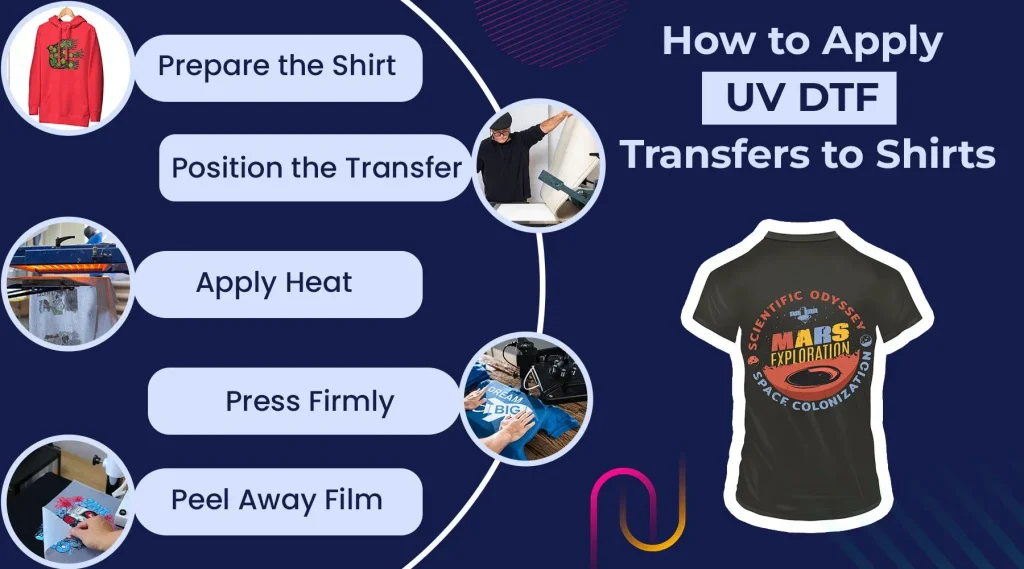
UV DTF transfer sits at the crossroads of chemistry, engineering, and design, propelling textile customization forward for brands and hobbyists alike. In this approach, UV-curable inks for textiles are printed onto a transfer film and then activated with UV light to form a durable image before transfer, enabling fast setup and reduced handling risk. The result is bright colors, fine details, and reliable adhesion when the design is heat-pressed onto fabric—an option increasingly favored. Understanding how UV DTF transfers work helps makers choose the right workflow, materials, and curing settings for longevity during wear and washing, while balancing cost and throughput. As with other fabric decoration techniques, this method offers strong results for a variety of fabrics and applications, from fashion to sportswear and promotional items.
In plainer terms, this approach can be seen as direct-to-film printing using UV-activated inks that polymerize under light to form a robust image. The print is then transferred to fabric via heat and pressure, creating vivid colors with good edge definition on a wide range of textiles. From an LSI perspective, related terms such as photo-initiated inks, heat-transfer film, and bonding mechanisms help connect this method to adjacent fabric decoration technologies. Compared with traditional DTF, this variant often promises faster curing, streamlined workflows, and adhesive choices that influence durability and wash resistance.
How UV DTF transfers work: from design to fabric adhesion
The UV DTF transfer workflow begins by printing the design onto a transfer film using UV-curable inks. These inks cure instantly when exposed to UV light, forming a solid image on the film. After printing, an adhesive layer is applied and prepared for transfer. With heat and pressure, the image bonds to the fabric, delivering bright colors, fine details, and flexible adhesion.
Understanding how UV DTF transfers work helps designers choose the right workflow, materials, and settings for durability. The transfer chain includes the ink chemistry, the film’s release properties, the adhesive, and the fabric substrate, all of which influence edge fidelity and washing performance.
The science of UV-curable inks for textiles: photoinitiators, cross-linking, and performance
UV-curable inks rely on photoinitiators that trigger rapid polymerization when exposed to UV light. The resulting cross-linked polymer network locks pigment in place, improving abrasion resistance and colorfastness compared with other ink types. For textiles, this chemistry supports bright, durable prints that resist fading after repeated wear and washing.
For textiles, substrate compatibility and adhesive bonding are crucial. The chemistry of the substrate and the adhesive layer determine how well the printed image bonds after transfer, contributing to edge adhesion and long-term wear. This interplay between ink, film, adhesive, and fabric shapes overall print performance.
DTF printing on fabrics: film, adhesive, and heat in action
DTF printing on fabrics uses a transfer film, a printed design with UV-curable inks, and an adhesive layer. After printing, depending on the process, powdering may be used to help the adhesive adhere; the image is then transferred to fabric by heat and pressure. This pathway blends film-based workflows with the bold color and detail achievable through UV inks.
Quality factors include print resolution, color management, and curing or drying speed. High-resolution DTF prints capture fine lines, but require careful drying and curing to prevent pigment migration and edge halos. Mastery of film release, adhesive distribution, and press settings is essential for consistent results across garments.
Fabric transfer technologies: options and tradeoffs for apparel and textiles
Fabric transfer technologies encompass UV DTF, traditional DTF, heat transfer vinyl, screen printing, and sublimation. UV DTF adds rapid curing and color stability to the DTF family, expanding the toolbox for designers and manufacturers. Each method has its own balance of feel, durability, and production workflows.
Choosing the right technology depends on fabric mix, garment feel, production volume, and wash durability. Each method has different implications for texture, stretch, and post-processing, so designers often blend approaches or select one based on the end-use, fabric type, and budget.
UV DTF vs traditional DTF: strengths, limits, and use cases
UV DTF vs traditional DTF reflects differences in ink chemistry and curing. UV-curable inks cure instantly under UV exposure, delivering faster production and improved color stability, while traditional DTF inks may require longer post-processing and have different curing dynamics. The result can be a crisper image with stronger resistance to wear.
Use cases where UV DTF shines include fabrics with challenging poly blends, fast-turn campaigns, and designs requiring crisp edges. Traditional DTF might be preferred for cost-sensitive runs, substrates where UV curing is impractical, or applications where a softer hand feel is prioritized.
Practical tips to optimize UV DTF transfers: color accuracy, adhesion, and longevity
To optimize results, start with color-managed design workflows, calibrate the printer with the fabric type, and plan for dot gain control. Ensure proper curing exposure to avoid under- or over-curing, which can affect wipe resistance and color fidelity.
Practical steps include film selection, adhesive choice, fabric prep, and test prints. Regular maintenance of UV lamps and print heads, plus appropriate heat press settings and preheating of garments, help maximize wash durability, edge adhesion, and overall print longevity.
Frequently Asked Questions
How does UV DTF transfer work and how does it compare with traditional DTF?
UV DTF transfer prints the design onto a transfer film using UV-curable inks, then cures the print with UV light to harden it on the film. An adhesive layer is activated and the image is transferred to fabric under heat and pressure. Compared with traditional DTF, UV DTF transfer benefits from faster curing, brighter colors, and strong edge definition, while remaining compatible with cotton, blends, and some synthetics—though substrate and adhesive choices still influence performance.
What are UV-curable inks for textiles, and why are they important for UV DTF transfer?
UV-curable inks for textiles rely on photoinitiators to trigger rapid polymerization under UV light, forming a durable, cross-linked matrix that improves wash durability and abrasion resistance. In UV DTF transfer, these inks enable quick curing, color stability, and reliable bonding during the transfer. Their performance depends on printer compatibility, the UV spectrum, fabric substrate, and adhesive chemistry.
What is DTF printing on fabrics, and how does UV curing fit into the transfer workflow?
DTF printing on fabrics involves printing the design onto a transfer film and transferring it to fabric with a bonding adhesive. In a UV DTF workflow, UV-curable inks are used for the film print, enabling fast handling and reduced smudging. The process may include a powdering step (or powder-free variants), adhesive application, and heat pressing to bond the image to the fabric.
Which fabrics are best with UV DTF transfer, and how do fabric transfer technologies influence results?
Cotton and cotton blends commonly yield vivid color and strong adhesion in UV DTF transfer, while some synthetic blends may require specific adhesives and curing parameters. This falls under fabric transfer technologies, where substrate type, transfer film chemistry, cure settings, and bonding chemistry collectively determine edge adhesion, flexibility, and wash durability.
How can I optimize curing, heat press settings, and adhesion for UV DTF transfer to maximize durability?
To optimize UV DTF transfer, fine-tune curing exposure, adhesive selection, and heat press parameters. Use appropriate UV exposure to avoid under- or over-curing, manage dot gain and color accuracy, and ensure clean film release and even adhesive bonding. Test on representative fabrics and adjust dwell time, temperature, and pressure for best edge integrity and wash durability.
What is the typical UV DTF transfer workflow from design to finish, including film, adhesive, and finishing steps?
A typical UV DTF transfer workflow starts with design preparation and color management, followed by printing on transfer film with UV-curable inks. The print is cured on the film (spot cure) or via a separate UV exposure, then adhesive is applied and activated, and the image is transferred to fabric under heat and pressure. Final checks assess edge adhesion, color vibrancy, and wash durability, aligning with best practices in UV DTF transfer and related fabric transfer technologies.
| Aspect | Key Points |
|---|---|
| What is UV DTF transfer? | UV DTF transfer combines Direct-to-Film (DTF) printing with UV-curable ink technology. The design is printed onto a transfer film, followed by applying an adhesive layer that is melted or activated; the image is transferred from the film to fabric under heat and pressure. The result is a vibrant, flexible print that adheres to a wide range of textiles, including cotton, blends, and some synthetics. This process is a variant of DTF printing that leverages UV-curable inks to boost curing speed and color stability during transfer. |
| Science behind UV-curable inks | UV-curable inks rely on photoinitiators embedded in the ink formulation. When exposed to ultraviolet light, reactive species—created by the photoinitiators—start a rapid polymerization process. The monomers and oligomers link together to form a three-dimensional network, locking the pigment in place and creating a robust polymer matrix. This cross-linking improves abrasion resistance, colorfastness, and wash durability compared with some traditional solvent- or water-based inks. For textiles, the ink must also bond effectively to the media after transfer, which is where the chemistry of the substrate and the adhesive layer comes into play. |
| Key factors that influence the process | – Ink chemistry and photoinitiators: UV-curable inks rely on precise photoinitiators tuned to the printer’s UV emission spectrum. The rate of cure, the degree of cross-linking, and the viscosity all affect print clarity, edge sharpness, and how well the image stays put during the transfer. – Print resolution and color management: Achieving crisp details requires appropriate dot gain control, color profiles, and calibration to the fabric type. High-resolution prints capture fine lines and halftones better, but they also demand careful drying and curing to prevent coffee-ring effects or pigment migration. – Film and carrier layers: The transfer film acts as the stage for the print. A good film has a precise release layer and a stable adhesive build-up to ensure clean separation and consistent transfer. – Adhesive chemistry and bonding: After printing, an adhesive layer is applied. The adhesive must bond evenly to the fabric under heat without leaving a sticky residue or cracking during wear. The interaction between adhesive, ink, and fabric determines edge adhesion and the longevity of the print. – Curing conditions: For UV DTF, the curing happens either during printing (spot curing) or as a separate UV exposure step. Proper exposure prevents under-curing (which can lead to poor wipe resistance) and over-curing (which can make the film brittle or reduce adhesion). |
| DTF printing on fabrics: how the transfer process comes together | A typical UV DTF transfer workflow includes several elements: the printer equipped with UV-curable inks, the transfer film, the adhesive, and a heat press. The steps usually go like this: 1) Design preparation: The artwork is prepared in color-managed workflows with attention to color accuracy and halftone balance. The image is sized to fit the target garment or textile piece. 2) Printing on transfer film: The design is printed onto the film using UV-curable inks. Because UV inks cure on contact with UV light, you can achieve quick handling times and reduce smudging risk during post-processing. 3) Powdering and curing: If the UV DTF process uses a powder-free approach, it may skip the adhesive powder. In many DTF workflows, a powdered adhesive is used; the workflow can vary and may include a curing stage before transfer. |
| Notes / Compatibility | – The transfer is versatile across textiles (cotton, blends, and some synthetics) depending on adhesive and ink compatibility. |
Summary
UV DTF transfer demonstrates how chemistry, engineering, and design come together to decorate fabrics with bright, durable prints. By printing with UV-curable inks on a transfer film and using a heat-activated adhesive, this approach aims for fast curing, strong adhesion, and color stability across textiles such as cotton and blends. The process hinges on the ink chemistry, the transfer film, the adhesive layer, and appropriate curing conditions, paired with careful design and color management to maximize edge sharpness and wash durability. Understanding these components helps designers and printers optimize workflows for fashion, sportswear, and merchandising applications.

