DTF printing is redefining how apparel designs come to life by pairing high-resolution digital artwork with a film-based transfer system and a carefully choreographed sequence of steps that lets you achieve vibrant, durable results on a wide range of fabrics, from cotton tees to performance blends. In this workflow, the DTF transfer film carries the design through the printing stage, typically with a white underbase for opacity on dark textiles, followed by a precise adhesive powder that is dusted onto the wet ink, cured, and then readied for heat pressing. The result is bold color density, clean edges, and a finish that remains comfortable to the touch after washing, with consistent opacity and sharpness across textured fabrics. Compared with some traditional methods, this approach can lower per-unit costs for small runs, shorten setup times, and streamline color management, making it appealing to hobbyists and shop owners who value flexibility and faster turnarounds. Key components—transfer film, white and color inks, adhesive powder, and a calibrated heat press—work together to create a scalable, repeatable process that supports on-demand production and expanding product lines.
Beyond the specific equipment, the concept aligns with other film-based decoration techniques and digital-to-fabric transfer ideas. In LS I terms, you can think of it as a film-carrier method where pigment inks are locked into a sheet before being applied to fabric. The emphasis shifts to color management, substrate compatibility, and workflow efficiency rather than the name of the machine. Practically, the results resemble vibrant, durable prints that feel natural on the fabric and resist fading after repeated washing. For producers, this translates into flexible inventory, easier testing of designs, and the opportunity to offer on-demand products without heavy minimums.
1) What is Direct-to-Film (DTF) Printing: Core Technology and How It Works
DTF printing, short for direct-to-film printing, sits within direct-to-film technology. This approach uses a film-based transfer system rather than printing directly onto fabric, delivering vibrant designs with strong color density. In practice, a design is printed onto a specialized transfer film, then bonded with a powder and cured before being heat-pressed onto the garment. The result is a workflow that blends inkjet-like accuracy with a film substrate, enabling bold colors on a wide range of fabrics and fabric blends.
DTF transfer film serves as the carrier for the ink, while white and color inks provide opacity and hue. The adhesive powder is crucial, melting and binding the film to the fabric during heat pressing. Understanding this core setup—DTF printing, the transfer film, white and color inks, and the bonding powder—helps you optimize the overall workflow from file preparation to the final press.
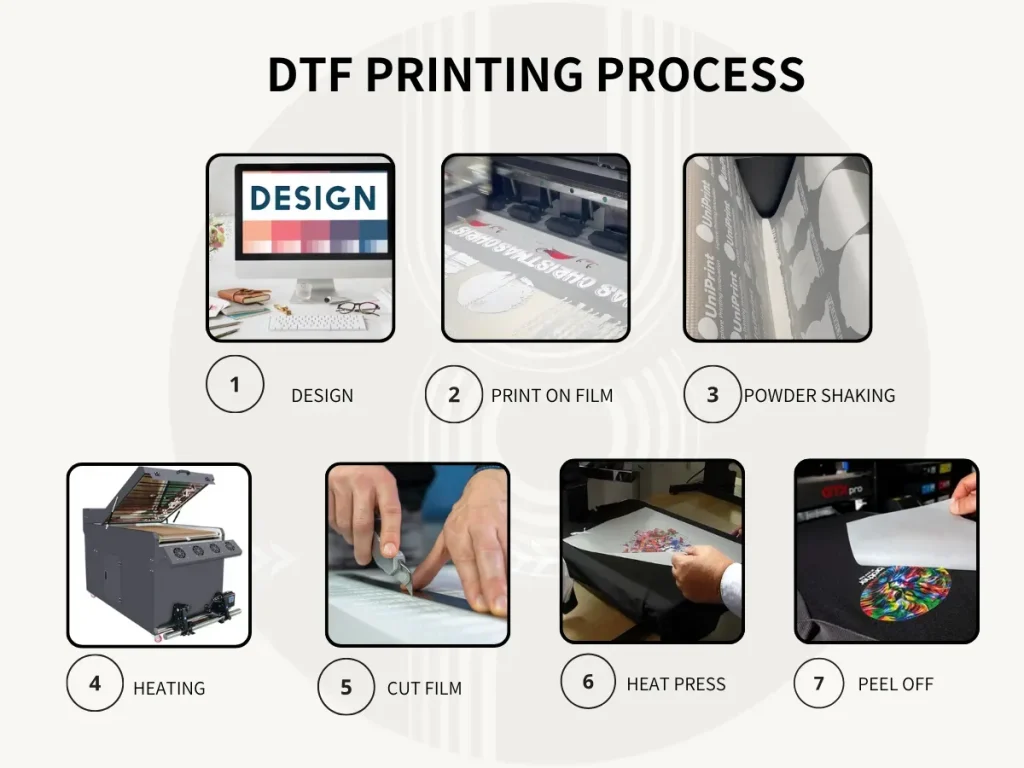
2) DTF Printing Process: A Step-by-Step Look from Design to Final Transfer
A typical DTF process starts with a digital design prepared in your preferred software. For dark fabrics, many operators begin with a white underbase on the transfer film to ensure bright, opaque color. The DTF printing process continues with the application of pigment inks that render the main artwork, followed by a light misting of clear or tinted coats to protect the print during handling.
After printing, adhesive powder is dusted onto the wet ink and cured or heated so the powder melts and bonds to the film. The transfer film is then aligned on the garment, covered with a protective sheet, and pressed in a heat-press at a temperature, time, and pressure specified for the materials. Once cooled and peeled, the transfer remains vibrant and durable, with color density that holds up well through washes.
3) DTF Transfer Film: Material Quality, Clarity, and Edge Sharpness
DTF transfer film quality strongly influences color transfer, edge sharpness, and overall durability. A film that is clear or slightly tinted can improve edge definition and reduce haloing, helping designs sit crisply on cotton, blends, and certain synthetics. Selecting the right transfer film is foundational to achieving predictable results across different fabrics and ink sets.
The film’s interaction with white and color inks, plus the curing process for the adhesive powder, determines how cleanly edges stay defined after heat pressing. Proper film handling—storing away from moisture and contaminants and choosing a film compatible with your pigment inks—supports consistent density, minimal bleeding, and improved wash performance.
4) DTF vs DTG: When to Choose Each Method for Different Fabrics and Runs
DTF vs DTG presents trade-offs that help you decide based on substrate, run length, and color requirements. DTF printing generally offers greater substrate versatility and cost efficiency for small to mid-sized runs, particularly when you need vibrant colors on dark fabrics. The film underbase in DTF supports strong opacity and contrast on a wide range of textiles, including blends and some synthetics.
DTG, by contrast, often excels on 100% cotton or lighter blends with a direct garment approach. It can be simpler for very high-volume runs on compatible fabrics but may require more frequent maintenance and careful color management. Understanding these differences—DTF vs DTG—helps you select the right method for each product line and fabric mix.
5) DTF Printers and Inks: Selecting Equipment for Durable, Vivid Transfers
Choosing the right equipment involves evaluating DTF printers and inks as a system. Many operators use standard inkjet printers configured for pigment inks with a dedicated white ink capability. The white ink layer is essential for achieving brightness on dark fabrics, while pigment-based color inks deliver vivid hues on the DTF transfer film. The combination of a compatible transfer film, reliable white ink, and robust color inks drives print density and wash durability.
Maintenance and consistency are critical. Regular tasks like printhead cleaning, nozzle checks, and ensuring the adhesive powder adheres evenly help prevent issues such as white gaps or powder clumping. When selecting a setup, consider printer durability, ink chemistry, nozzle reliability, and the overall cost-per-transfer to maintain sustainable, high-quality results.
6) Optimizing Your DTF Workflow: Color Management, Curing, and Post-Press Care
A well-optimized DTF workflow begins with color management. Calibrated monitors, ICC profiles, and proof sheets help achieve predictable color reproduction from design to print. Planning with a white underbase for dark fabrics, and precise layer ordering, reduces color bleed and preserves sharpness when transferring to textured fabrics.
Curing parameters, powder consistency, and heat-press settings are the other pillars of durability. Proper curing ensures the adhesive bonds evenly to the film, while accurate temperature, time, and pressure maximize bond strength without scorching fabrics. Post-press care, including recommended washing guidelines and storage practices for films and powders, helps sustain color vibrancy and transfer longevity over many wears and washes.
Frequently Asked Questions
What is DTF printing and how does direct-to-film technology work?
DTF printing, short for Direct-To-Film printing, uses direct-to-film technology to print designs on a clear transfer film. The typical workflow prints a white underbase and color layers on the film, dusts the surface with adhesive powder, cures it, and then heat-presses the film onto the garment. This approach delivers vibrant color density, strong wash durability, and broad fabric compatibility, making it well-suited for small runs and diverse textiles.
How does the DTF printing process compare to DTG, and when should you choose DTF over DTG?
DTF printing process and DTG differ in substrate flexibility, setup, and workflow. DTF offers broad fabric compatibility and typically lower setup costs for small runs, with strong color on dark fabrics due to the film underbase. DTG excels on 100% cotton with a very soft hand but may require more maintenance and have higher per-unit costs for certain runs. Choose DTF for mixed fabrics, darker garments, or quick, small-batch production; choose DTG when your work is mostly on 100% cotton and you prioritize a very soft feel.
What is the role of the DTF transfer film in the workflow and how does it affect color and durability?
DTF transfer film acts as the carrier for the printed artwork. The process uses white and color inks on the film, followed by adhesive powder that bonds the print to fabric during heat pressing. The quality of the DTF transfer film influences edge sharpness, color density, and wash durability, so selecting a reliable film and proper curing parameters is essential for lasting results.
What should I consider when choosing DTF printers and inks for reliable results?
When selecting DTF printers and inks, prioritize white-ink capability, robust pigment-based inks, and reliable nozzle performance. Look for compatibility with DTF transfer film and a straightforward maintenance routine to prevent issues like white gaps or powder clumping. A good setup includes a standard inkjet platform with a dedicated white-ink channel, proper curing, and consistent powder adhesion.
How do design and prepress steps optimize results when using DTF transfer film printing?
Design and prepress for DTF printing should emphasize color management, layer order, and print readiness. Calibrate monitors with ICC profiles, include a white underbase for dark fabrics, and use 300 DPI or higher (vector art where possible) for sharp edges. Plan the white underbase first, manage bleed for seams, and test on target fabrics to confirm cling, stiffness, and wash retention.
Is DTF printing cost-effective for small runs compared to DTG or traditional screen printing?
In many cases, DTF printing is cost-effective for small runs due to lower setup costs and efficient batch processing. ROI depends on order size, turnaround, and material waste; for very small volumes, DTF can outperform screen printing and remain competitive with DTG. Consider fabric variety, desired color density, and wash durability when choosing between DTF printing, DTG, or other methods.
| Aspect | Key Points |
|---|---|
| What is DTF Printing? | Direct-to-film bonding: print on transfer film, apply adhesive powder, cure, then heat-press onto fabric; works on many fabrics; advantages include cost efficiency for small runs, easier color management, and broad textile compatibility. |
| How It Works | Design is printed on a PET transfer film (often with a white underbase for dark fabrics), powder is dusted and cured, then the film is heat-pressed onto the garment to create a durable transfer with vibrant color density. |
| DTF vs DTG | DTF is versatile across fabrics and often cheaper for small runs; DTG excels on 100% cotton. White underbase is crucial for both; DTF’s film underbase yields opacity on dark fabrics; maintenance differs (film/powder vs ink flow/heads). |
| Materials | Key parts are the transfer film, white and color pigment inks, and adhesive powder. White ink enables brightness on dark fabrics; choose a printer capable of white ink; regular maintenance ensures consistent bonding and wash durability. |
| Design & Prepress | Calibrate color management (ICC profiles), design with white underprint for dark fabrics, prefer vector art and 300 DPI+ raster images, plan layer order (white underbase first), account for bleed/edge handling, and test fabric compatibility. |
| Starting a Workflow | Prepare design with white underbase if needed, print on transfer film with pigment inks, dust and cure powder, place film on fabric with protective sheet, heat-press at appropriate settings, cool and peel, with optional second press for bond strength. |
| Common Issues | White gaps, faint colors, powder adhesion problems, or cracking after wash; fixes include adjusting underbase density, verifying color profiles, ensuring even powder application, matching heat-press parameters, and following garment care instructions. |
| Costs & Sustainability | Upfront printer/film/ink/heat press costs with favorable per-unit cost for small runs; ROI depends on volumes; sustainable practices include low-tox inks/films, waste management, energy-conscious pressing, and batch optimization to reduce waste. |
| Pros, Use Cases & Limitations | Strong color density and fabric versatility make it ideal for on-demand merchandise, custom apparel, and small-batch designs; test fabrics due to varied heat responses; for very high-volume runs or special finishes, traditional methods may still be preferred. |
| Tips for Beginners | Define target fabrics and build a test swatch library, establish color management routines, keep a simple repeatable workflow with documented settings, perform regular maintenance, and record which films/powders/inks yield best durability. |
Summary
Conclusion: DTF printing offers a flexible, cost-effective path to high-quality transfers across a broad range of fabrics. By understanding the core technology—transfer film, white and color inks, adhesive powder, and the heat-press process—you can design durable transfers with strong color density and wash resistance. The technology sits between screen printing and DTG, combining broad substrate compatibility with relatively simple setup for small runs. With careful workflow design, proper materials selection, and ongoing maintenance, DTF printing can expand product offerings and improve production efficiency for hobbyists and shop owners alike.